Homeowners often assume switching to a tankless water heater completely eliminates water leak risks because there is no 50-gallon water tank waiting to burst. While tankless systems eliminate large volume ruptures, they introduce different hydraulic failure points that require proper maintenance.
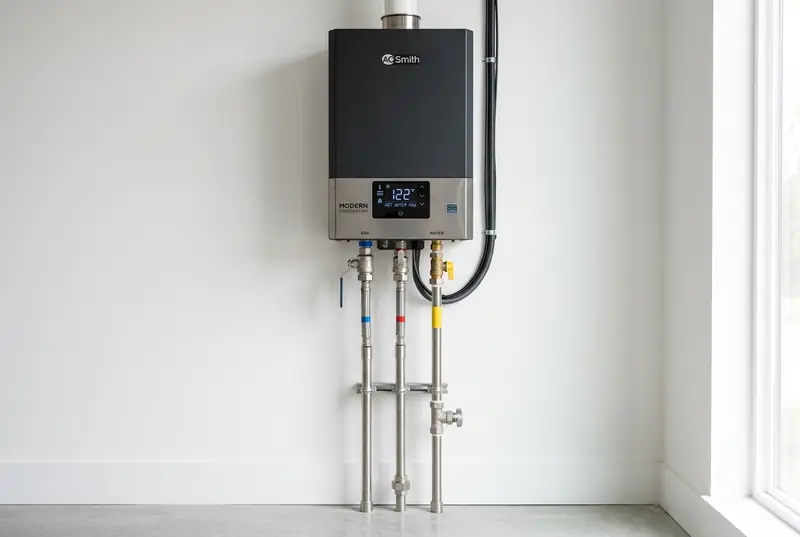
Failure Mode Comparison Table
| Feature / Failure Point | Traditional Storage Tank | Tankless On-Demand Unit |
|---|---|---|
| Worst-Case Leak Volume | 40–80 Gallons + Continuous Mains Flow | Continuous Mains Flow if Piping Breaks |
| Primary Corrosion Cause | Sacrificial anode rod depletion; bottom sediment overheating | Copper heat exchanger scaling & acidic condensate acid backup |
| Average Lifespan in Knoxville | 8 to 12 Years | 15 to 20 Years (With Annual Flushes) |
| Typical Warning Signs | Popping noises, base rust, T&P drip | Diagnostic error codes, lukewarm water, cabinet drips |
Why Both Require Regular Knoxville Maintenance
Whether you choose tankless or traditional storage, East Tennessee's hard water demands protection. Storage heaters require anode rod inspection every 3 years and annual sediment draining. Tankless units require annual vinegar descaling to maintain heat transfer efficiency and prevent pinhole combustion breaches.
Need Help Choosing or Repairing?
Our team repairs both systems. Explore our tankless repair services or call +1 (865) 856-9052 to speak with a technician.
How Tank Water Heaters Fail
A storage tank fails from the inside out. The glass lining that protects the steel always has hairline flaws, and the anode rod sacrifices itself to guard those weak spots. The trouble starts when the rod dissolves completely, which happens faster in Knoxville's mineral-heavy water than most owner's manuals assume. Once the rod is gone, corrosion moves to the tank wall. Rust blooms around the bottom seam and the welded fittings, the steel thins, and eventually the tank weeps, then splits. A full bottom-seam rupture releases the entire tank at once, which is why a failed tank can put standing water across a garage or utility room in minutes.
Not every tank leak is a death sentence for the unit. The temperature and pressure relief valve weeps when thermal expansion has nowhere to go or the valve itself wears out. Inlet and outlet nipples corrode where dissimilar metals meet. Drain valves drip after a flush disturbs old sediment. Those are fitting problems, and a water heater repair visit can usually resolve them without replacing the tank. The dividing line is location: water from a fitting can be fixed, while water seeping from the tank body, a seam, or a rust bloom means the steel itself has given up. Our anode rod inspection guide explains how to keep a tank on the right side of that line.
How Tankless Units Fail
Tankless heaters trade the big-tank rupture for a different set of vulnerabilities. The heart of the unit is a copper or stainless heat exchanger with narrow waterways, and Knoxville's hard water coats those passages with scale. Scale insulates the metal, creates hot spots, and over time can open pinholes that drip inside the cabinet. Annual descaling prevents nearly all of it, but skipped maintenance is the most common reason tankless units start leaking.
Seals and o-rings are the second weak point. A tankless unit packs flow sensors, valves, and connections into a compact box, and every one of those joints can weep as gaskets age. Condensing models add a condensate drain that carries mildly acidic water away; if that line clogs, acidic water backs up into places it should never sit. Freeze damage is the East Tennessee special case: tankless units rely on electric freeze-protection heaters that only work when the unit has power. A winter outage during a hard freeze can split the heat exchanger, which is why units in garages and exterior walls deserve extra attention. See our tankless water heater repair page for what a service visit covers.
Which Failure Is Worse for Your Home?
Honestly, it depends on where the unit sits and how the failure unfolds. A tank rupture is the single most dramatic residential plumbing failure: tens of gallons released at once, plus continuous flow from the supply line until someone closes the valve. A tankless leak is usually a slower affair, a drip from a seal or pinhole that soaks a wall cavity over weeks. But both units are fed by the same pressurized supply line, so a broken pipe connection on either one flows indefinitely.
Location decides the damage bill more than the technology does. A tank in a garage with a floor drain is forgiving. The same tank in a finished basement, an upstairs closet, or an attic platform is a flood waiting for a calendar date. Tankless units mounted on exterior walls or in tight closets can hide slow drips behind the cabinet for months. Whichever type you own, the two cheapest protections are identical: a drain pan with a plumbed drain under a tank, and a water alarm or automatic shutoff valve on the supply line. Know where your main shutoff is before you need it; our emergency shutoff guide shows you what to look for.
Cutting Leak Risk for Either System
- Keep up with the maintenance each type demands. Tanks want anode checks and periodic flushing; tankless units want yearly descaling. Skipped maintenance is the root cause behind most leak calls.
- Put a leak detector on the supply line. Electronic detectors with automatic shutoff valves close the water the moment they sense moisture, and they cost far less than a single insurance deductible.
- Give tanks a real drain pan. A pan that drains to the exterior or a floor drain turns a rupture from a flood into a cleanup.
- Watch the relief valve discharge line. A T&P line that drips into a bucket or onto the floor is telling you something; trace it back instead of emptying the bucket.
- Protect tankless units from freezes. Keep power to the unit during cold snaps, insulate exposed piping, and know that the built-in freeze protection cannot help during an outage.