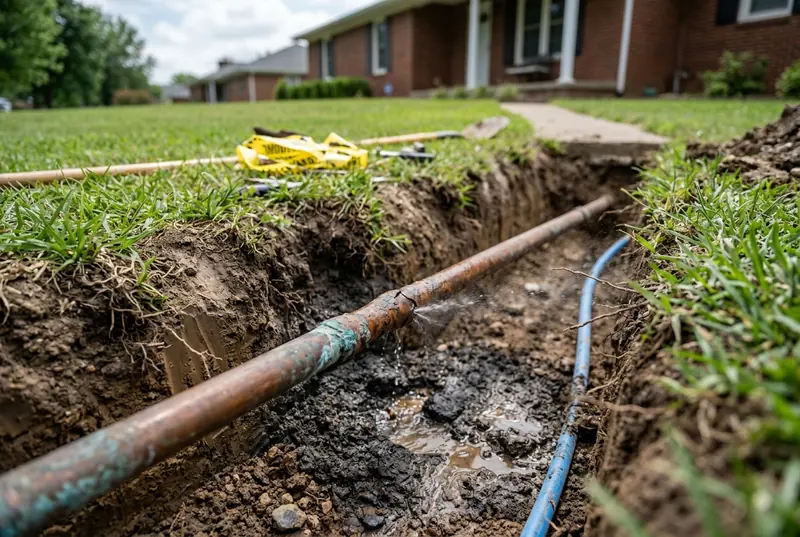
Underground & Sub-Slab Water Leak Detection in Knoxville
Locating subterranean water leaks beneath concrete foundation slabs, driveways, and main service yard lines with pinpoint acoustic correlators and helium tracer gas diagnostics.
The Anatomy of a Knoxville Slab Leak
Many homes built throughout Knoxville, Farragut, and Knox County are constructed on concrete slab-on-grade foundations. Potable hot and cold water lines are routed through or beneath the concrete slab before emerging at fixtures. Slab leaks occur due to:
- Copper Pinhole Electrolysis: Acidic soil chemistry and friction against rock bedding rub through soft copper tubing over 15 to 25 years.
- Shifting East Tennessee Clay Soil: Expansive clay soils expand in wet seasons and contract during summer droughts, causing differential slab settlement that stresses buried plumbing lines.
- Thermal Expansion Friction: Hot water supply lines continuously expand and contract as hot water is used, wearing thin where pipes contact coarse gravel or rebar.
Tracer Gas & Ultrasonic Frequency Correlation
When concrete slabs are too thick or ambient noise prevents acoustic isolation, we introduce medical-grade inert tracer gas (95% nitrogen, 5% hydrogen) into the depressurized water line. The microscopic gas molecules escape through the leak and permeate through the concrete slab, where our sensitive molecular gas sniffers pinpoint the leak position to within inches.
Direct Spot Repair vs. Overhead Reroute
Once the subterranean leak is mapped, we provide clear options: a targeted single-tile spot excavation for localized repairs, or an overhead PEX bypass through the attic that completely abandons leaking lines under the slab forever.
Need Sub-Slab Leak Diagnostics?
Call our Knoxville dispatch desk immediately at (865) 856-9052 or view our Knox County service coverage map.
Signs of a Hidden Underground Leak
Underground leaks rarely announce themselves with a puddle. They whisper through secondary clues, and learning the vocabulary saves real money, because every month of delay is water bought and soil eroded. Watch for these:
- A water bill that jumps without explanation. Compare against the same month last year, not last month; seasonal irrigation masks leaks. A sustained increase with no habit change is the classic first sign.
- The meter spins with everything off. Shut off every fixture, then watch the meter's leak indicator. Movement means water is leaving the system somewhere between the meter and your taps.
- Warm spots on the floor. A hot-water slab leak heats the concrete above it. Walk barefoot across slab rooms; a distinct warm patch that never cools is diagnostic.
- The sound of running water. Press your ear to a wall or floor in a quiet house. A faint hiss or rush with all fixtures off is pressurized water escaping.
- Damp or sunken ground outside. Service-line leaks saturate soil along the pipe run, leaving mushy patches, unusually green strips of grass, or settling near the foundation.
- Falling water pressure. A significant breach steals pressure from the whole house, most noticeably in showers.
- Cracks in floors or walls. Eroded soil under a slab lets sections settle unevenly, opening cracks that were not there last year.
How Detection Works, Step by Step
Modern leak detection is a process of elimination that ends with a mark on the ground, not a trench across the yard. A typical visit runs like this:
- Interview and meter check. The technician starts with your symptoms and confirms the leak at the meter, establishing how much water is escaping. A fast leak and a slow seep get different search strategies.
- Isolation testing. Valves divide the system into sections: house versus service line, hot versus cold, irrigation versus potable. Each section is watched at the meter or pressure-tested to narrow the search to one branch.
- Acoustic survey. Ground microphones and listening discs scan the suspect run. Pressurized water escaping through a pinhole makes a distinct high-frequency hiss that travels through soil and concrete, and experienced ears can follow it to within a few feet.
- Line locating. A locator traces the buried pipe's actual path, which often differs from where the original installer supposedly ran it. Knowing the true route keeps the search on the pipe instead of beside it.
- Tracer gas when acoustics struggle. For leaks under thick slabs or in noisy environments, an inert gas mix is introduced into the isolated line. The gas escapes at the breach, rises through the concrete, and a sensitive sniffer marks the spot, often within inches.
- Marking and mapping. The located point is marked and photographed, with depth estimates and notes on surface materials above it. You get a clear picture of what excavation, if any, the repair will require.
The whole approach is designed to minimize digging. Pinpointing first means the repair opens one small area instead of exploratory trenches, which matters enormously when the leak sits under a driveway, patio, or finished floor. Our underground leak guide explains the Knoxville soil factors that shape this work.
Emergency or Schedule Soon?
A gushing service line, water bubbling up through the yard, or a sinkhole forming near the foundation is an emergency: close your main shutoff valve and call immediately. Rapid soil erosion can undermine driveways, walkways, and slab edges within days. A slow seep, a gradually climbing bill, or a warm floor spot is not a midnight emergency, but treat it as a schedule-soon priority. Underground leaks never heal themselves; they widen as escaping water erodes the soil around the breach, and the repair only gets bigger with time. If you are unsure which category you are in, describe the meter behavior when you call (865) 856-9052; a licensed local plumber can usually gauge urgency from that alone.
What Drives the Cost
Detection and repair price on different logic, but both follow the same cost drivers:
- Depth and surface material. A shallow line under grass is quick to expose; the same leak under a concrete driveway or inside a finished slab takes far more labor to reach.
- Distance from the meter. Long service runs take longer to survey and isolate, especially when the pipe's actual route is unknown.
- Line material and age. Older copper with electrolytic pitting may have multiple weak points, which can turn a single repair into a section replacement.
- Precision of the locate. Accurate pinpointing shrinks the excavation to a single small opening; a vague location means a bigger hole and more restoration.
- Restoration needs. Re-pouring concrete, relaying pavers, or repairing landscaping after the fix is part of the true project cost.